Think of this:
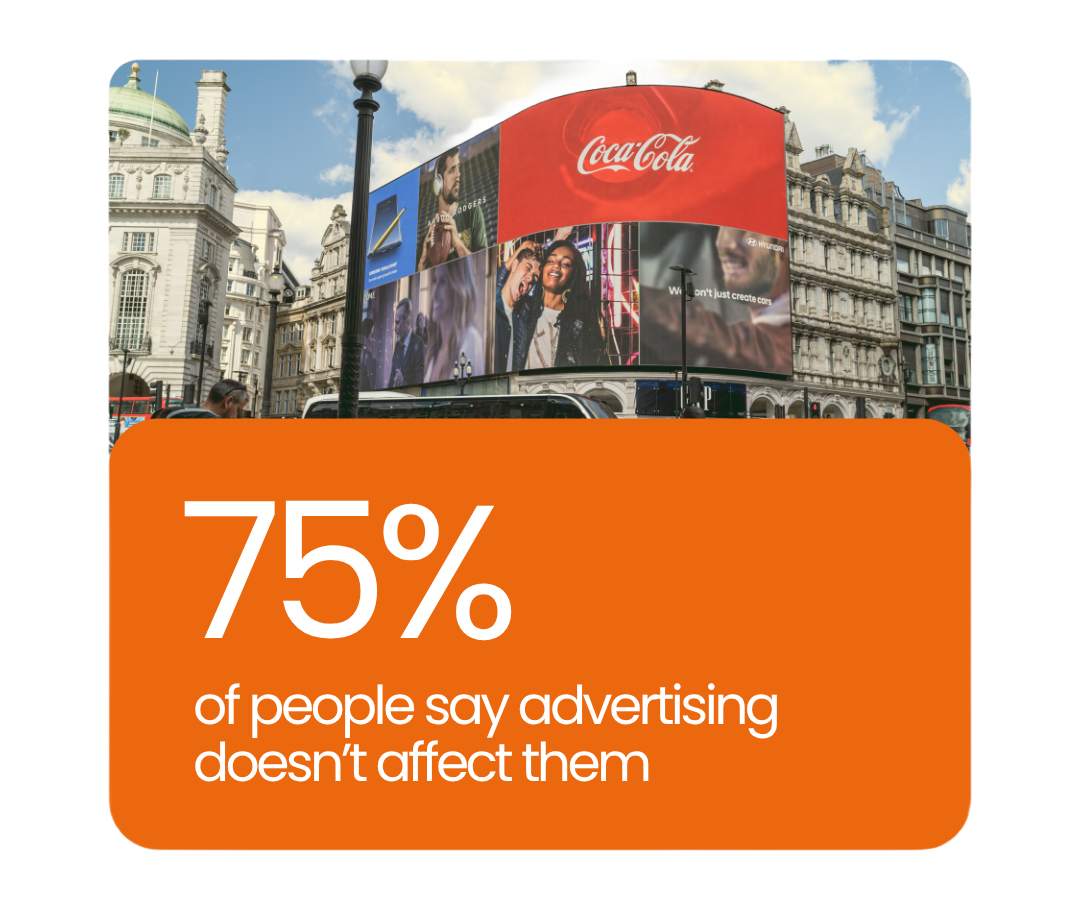
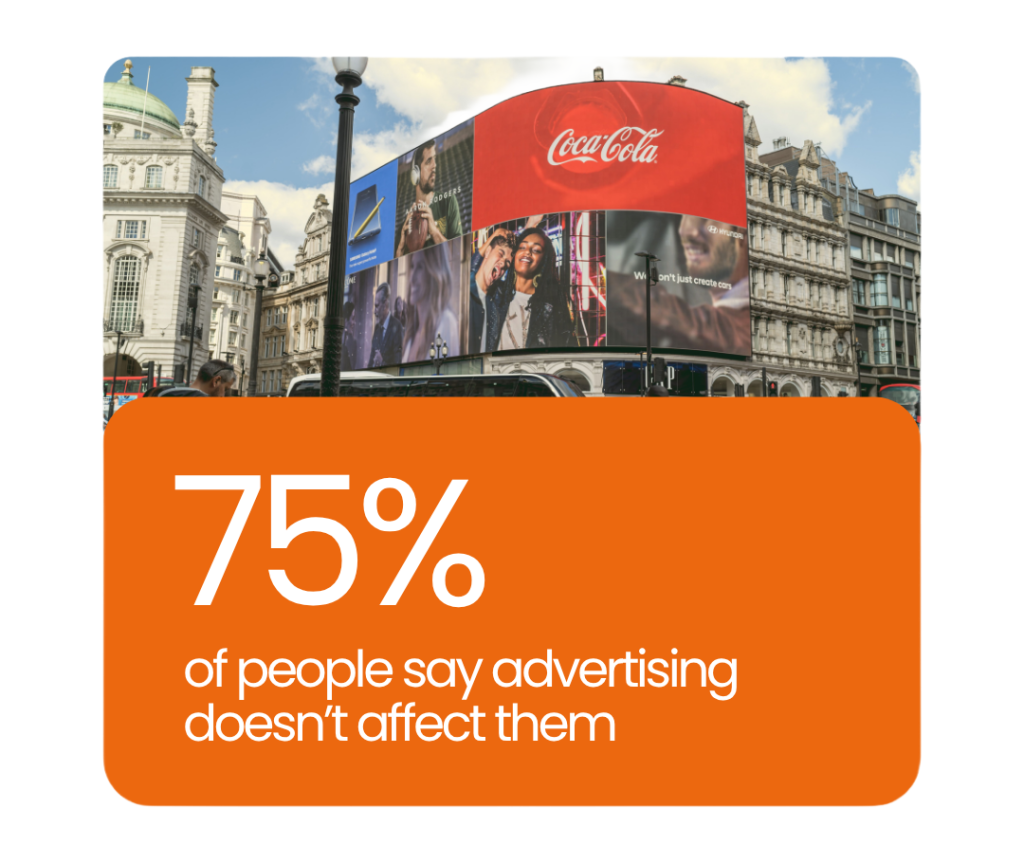
75% of people asked to rate an ad, claim advertising doesn’t affect them.
So what exactly are they rating?
And why are we asking them to tell us in the first place?
The bias nobody talks about
In 1983, a sociologist named W. Phillips Davison described something he called the third-person effect which is the very human tendency to believe that media messages, particularly advertising and persuasive content, have a much greater influence on other people than on ourselves.
The “third person” in the name suggests the person being influenced is always someone else, “I’m not affected by advertising. Others might fall for it, but not me”.
Davison was describing a pattern that has since been replicated across dozens of studies. Research at Stanford tested the effect across multiple media types and kept finding the same thing: people consistently rate the influence of advertising on others significantly higher than on themselves.
Further work by researchers Richard Perloff and Bryant Paul, who reviewed over thirty studies on the subject, confirmed that this effect is robust and remarkably consistent. We genuinely believe we’re different, more rational, more resistant, more savvy than the average person swayed by clever marketing. We’re not.
Why it gets worse with advertising specifically
This is where it gets really inconvenient for the industry. The third-person effect is strongest precisely for content that feels manipulative or commercially motivated. The more someone perceives a message as an attempt to sell them something, the more convinced they become that it might work on others, but definitely not on them.
Research from Cornell University showed that the bias intensifies when the content is seen as undesirable or manipulative, when the person considers themselves well-informed about the topic, and critically, when the influence is subtle and unconscious rather than obvious. Advertising scores on almost all of these conditions.
So when you put someone in a research setting and ask them to evaluate an advertisement, something they’re already primed to see as a commercial persuasion attempt, you’ve essentially handed them every psychological reason to under-report its effect on them personally.
Don't ask someone to taste something they've decided they won't enjoy
Here’s a simple analogy that captures what’s actually happening in most ad research.
Imagine you’re asked to taste-test a new dish. It’s been made specifically for you and your preferences, so you’re exactly the intended audience. However, before it even arrives at the table, you’ve already decided you won’t enjoy it. Maybe you don’t trust the chef, or maybe you’ve had bad experiences with this kind of food before.
The dish arrives, you try it, and your feedback is underwhelming. Was the food bad? Maybe, or maybe your prior conviction got there before your taste buds did.
This is exactly what happens in ad testing, except the industry rarely acknowledges it, and it is worth repeating: survey data consistently shows that somewhere around 75% of consumers believe advertising doesn’t significantly influence their own decisions.
Yet when you look at actual behaviour, the picture is completely different. One of the most persistent distortions in consumer self-reporting is that respondents frequently claim low impact from sources they view as overtly commercial, like TV ads or influencer endorsements, even when their actual behaviour says otherwise.
We know this from our own implicit research, even with one or two viewings, an ad will affect brand perception immediately. You’re asking people to evaluate something they’ve already decided doesn’t work on them so the results you get aren’t feedback on the ad, but a reflection of how people prefer to see themselves.
What the brain knows that people won’t admit
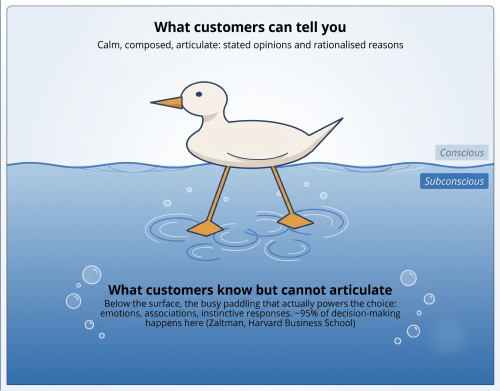
While consumers are telling researchers that ads don’t influence them, their brains are doing something else entirely. Brain imaging studies have found that exposure to advertising activates reward centres and shapes brand preferences unconsciously, in the very people who claim to be immune. Harvard Business Review has cited research suggesting that up to 95% of consumer decisions are made subconsciously, driven by emotion and memory rather than rational deliberation.
People evaluate their purchase after they’ve already made it, then construct a rational explanation for something that was never really rational to begin with.
This is the core problem with asking people how advertising affects them: they don’t know. Not because they’re lying, but because most of the influence is happening below the level of conscious awareness.
Traditional surveys and focus groups simply can’t capture what’s driving behaviour when the driver is subconscious. It’s why major brands have increasingly turned to neuromarketing including methods like implicit testing, EEG, and eye-tracking, to measure what the brain actually does in response to an ad, rather than what people say afterwards. The gap between the two can be huge.
The industry’s awkward silence
What makes this odd is that the advertising industry knows advertising works. Billions are spent on it every year precisely because the evidence, from sales data, and brand tracking, confirms that well-made advertising influences people.
Yet the standard methodology for evaluating a new ad before it runs is still often to gather a group of people and ask them what they think about it. People who, by definition, will underestimate its influence on themselves.
There’s a useful distinction here between declared behaviour and actual behaviour. When researchers ask consumers where they prefer to get product information, the top answers are things like “my own research” and “word of mouth.” Advertising almost never makes the list. Yet advertising continues to shape what people consider worth researching, what they search for, what they recognise on a shelf, and how they feel about a brand when they encounter it.
So, people aren’t lying, they genuinely believe they make their own decisions independently. The third-person effect isn’t cynicism, it’s a sincere belief, held strongly, that turns out to be largely wrong.
So what should we do about it?
The answer isn’t to abandon consumer research but to accept that people can’t accurately tell you how advertising affects them, and design your research around that reality rather than against it.
That means shifting away from questions about influence and towards questions about experience such as ‘How did the ad make you feel? What did it remind you of? What kind of person did you imagine using that product?’. These questions don’t trigger the same defensive self-perception, and they produce much more honest and useful responses.
It also means paying closer attention to what people do rather than just what they say, and this is where implicit testing becomes genuinely valuable. Implicit methods work precisely because they measure the subconscious mind. Rather than asking someone whether an ad affected them, you measure things they can’t easily control or edit such as reaction times to brand-related words, or unconscious associations. The gap between what someone says about an ad and what their body and brain are doing while they watch it can tell a lot.
This matters because the third-person effect is fundamentally a conscious phenomenon. It’s a story people tell themselves about their own resistance to influence and implicit measures don’t ask for that story.
Lastly, it means being more thoughtful about the frame you put people in. The moment you ask someone to “evaluate an advertisement,” you’ve handed them a role: critical observer, not affected consumer. That role comes pre-loaded with the conviction that they won’t be influenced. Change the frame to talk about the story, the world the ad creates, and the characters in it, and you often get a completely different quality of response.
This is all about designing research that works with human psychology rather than pretending it doesn’t exist.
The bigger picture
There’s something almost philosophically interesting about all of this. Advertising is an industry built on the understanding that human behaviour can be shaped without people fully realising it, and yet the primary research method for testing whether an ad achieves this relies on asking people what they think about it.
W. Phillips Davison identified this gap over forty years ago. The challenge for anyone doing serious advertising research isn’t to dismiss what consumers say but to understand that what they say about themselves and advertising is itself a kind of performance. A story they tell to preserve the idea that they’re in control.
References:
Davison, W. P. (1983). The third-person effect in communication. Public Opinion Quarterly, 47(1), 1–15. https://doi.org/10.1086/268763
Hasnaoui, A., Benabdallah, M., & Djebbari, Z. (2023). Consumer attitudes and behavioural responses shaped by unconscious neural developments. In Frontiers in Neuroergonomics. https://doi.org/10.3389/fnrgo.2025.1542847
Paul, B., Salwen, M. B., & Dupagne, M. (2000). The third-person effect: A meta-analysis of the perceptual hypothesis. Mass Communication and Society, 3(1), 57–85. https://doi.org/10.1207/S15327825MCS0301_04
Perloff, R. M. (1993). Third-person effect research 1983–1992: A review and synthesis. International Journal of Public Opinion Research, 5(2), 167–184. https://doi.org/10.1093/ijpor/5.2.167
Perloff, R. M. (1999). The third-person effect: A critical review and synthesis. Media Psychology, 1(4), 353–378. https://doi.org/10.1207/s1532785xmep0104_4
Perloff, R. M., & Shen, L. (2023). The third-person effect 40 years after Davison penned it: What we know and where we should traverse. Mass Communication and Society, 26(3), 384–413. https://doi.org/10.1080/15205436.2022.2134802
Latest Posts
Join Our Newsletter
Subscribe to our email newsletter to keep up to date with our latest insights, news, and findings on market research, implicit testing and our occasional psychological ‘neuro-nuggets’ of wisdom.
Our blog

The Free Sample Trap: Why On-the-Spot Feedback Tells You What People Think You Want to Hear
Six years ago we created a comic strip about a couple trying a free product sample at a shopping centre. At the

Your Customers Know More Than They Can Tell You
Every year, thousands of new products launch on the back of research that said they would succeed. Concept tests came back positive. Focus groups nodded along. Survey respondents said,
You think ads don’t work on you. That’s exactly the problem.
75% of people asked to rate an ad, claim advertising doesn’t affect them.
So what exactly are they rating? And why are we
Many of our clients have built up a rich body of research over time. A common question we hear is how to get more value from that existing data, rather than constantly running new studies.
One of our current priorities is helping clients do exactly that.
As part of this, we’re introducing a small number of AI-assisted tools into our research approach. These are always used alongside traditional research methods, never as a replacement.
- A digital twin approach, which uses real consumer data to model likely responses to new ideas or claims within specific audiences.
- A predictive modelling tool that explores how different features or benefits may influence emotional response, evaluation, and choice.
Many current predictive approaches in marketing rely on generative AI techniques to create synthetic data and model consumer behaviour (Madanchian, 2024). These methods can be powerful for exploring potential outcomes, but they are often limited by the assumptions built into the models (you can read more about this in our previous blog post here).
Our approach uses digital twins built from observed data, keeping simulations based on real behaviour (Hornik & Rachamim, 2025). This allows us to model likely reactions to new ideas or claims while reducing unnecessary repetition and helps focus live research where it adds the most value.
Clients don’t need to become experts in AI to use these approaches. Our in-house AI team handles the technical side, focusing on translating outputs into clear, practical brand implications, led by our CEO, Dr Eamon Fulcher, who holds a PhD in AI from Imperial College London.
As ever, our focus remains on robust research, clear thinking, and helping clients make confident decisions.
If this approach interests you or you have a current problem you need to solve, please get in touch here.
References:
Hornik, J., & Rachamim, M. (2025). AI-enabled consumer digital twins as a platform for research aimed at enhancing customer experience. Management Review Quarterly. https://doi.org/10.1007/s11301-025-00527-3
Madanchian, M. (2024). Generative AI for Consumer Behavior Prediction: Techniques and Applications. Sustainability, 16(22), 9963. https://doi.org/10.3390/su16229963
Latest Posts
Join Our Newsletter
Subscribe to our email newsletter to keep up to date with our latest insights, news, and findings on market research, implicit testing and our occasional psychological ‘neuro-nuggets’ of wisdom.
Our blog
The Free Sample Trap: Why On-the-Spot Feedback Tells You What People Think You Want to Hear
Six years ago we created a comic strip about a couple trying a free product sample at a shopping centre. At the
Your Customers Know More Than They Can Tell You
Every year, thousands of new products launch on the back of research that said they would succeed. Concept tests came back positive. Focus groups nodded along. Survey respondents said,
You think ads don’t work on you. That’s exactly the problem.
75% of people asked to rate an ad, claim advertising doesn’t affect them.
So what exactly are they rating? And why are we
Many of our clients have built up a rich body of research over time. A common question we hear is how to get more value from that existing data, rather than constantly running new studies.
One of our current priorities is helping clients do exactly that.
As part of this, we’re introducing a small number of AI-assisted tools into our research approach. These are always used alongside traditional research methods, never as a replacement.
- A digital twin approach, which uses real consumer data to model likely responses to new ideas or claims within specific audiences.
- A predictive modelling tool that explores how different features or benefits may influence emotional response, evaluation, and choice.
Many current predictive approaches in marketing rely on generative AI techniques to create synthetic data and model consumer behaviour (Madanchian, 2024). These methods can be powerful for exploring potential outcomes, but they are often limited by the assumptions built into the models (you can read more about this in our previous blog post here).
Our approach uses digital twins built from observed data, keeping simulations based on real behaviour (Hornik & Rachamim, 2025). This allows us to model likely reactions to new ideas or claims while reducing unnecessary repetition and helps focus live research where it adds the most value.
Clients don’t need to become experts in AI to use these approaches. Our in-house AI team handles the technical side, focusing on translating outputs into clear, practical brand implications, led by our CEO, Dr Eamon Fulcher, who holds a PhD in AI from Imperial College London.
As ever, our focus remains on robust research, clear thinking, and helping clients make confident decisions.
If this approach interests you or you have a current problem you need to solve, please get in touch here.
References:
Hornik, J., & Rachamim, M. (2025). AI-enabled consumer digital twins as a platform for research aimed at enhancing customer experience. Management Review Quarterly. https://doi.org/10.1007/s11301-025-00527-3
Madanchian, M. (2024). Generative AI for Consumer Behavior Prediction: Techniques and Applications. Sustainability, 16(22), 9963. https://doi.org/10.3390/su16229963
Latest Posts
Join Our Newsletter
Subscribe to our email newsletter to keep up to date with our latest insights, news, and findings on market research, implicit testing and our occasional psychological ‘neuro-nuggets’ of wisdom.
Our blog
The Free Sample Trap: Why On-the-Spot Feedback Tells You What People Think You Want to Hear
Six years ago we created a comic strip about a couple trying a free product sample at a shopping centre. At the
Your Customers Know More Than They Can Tell You
Every year, thousands of new products launch on the back of research that said they would succeed. Concept tests came back positive. Focus groups nodded along. Survey respondents said,
You think ads don’t work on you. That’s exactly the problem.
75% of people asked to rate an ad, claim advertising doesn’t affect them.
So what exactly are they rating? And why are we