Understanding Emotional Response to Email Marketing
Email marketing is one of those things every brand uses, but very few understand what it actually does to their brand. Some emails feel engaging and
Quantitative market research is the backbone of most brand and product decisions. You need numbers, sample sizes that hold up statistically, data you can segment, and results you can present to a room. Concept testing, brand tracking, pricing research, ad testing, and claim evaluation are all quantitative problems which need quantitative answers.
Split Second Research is a quantitative market research agency. That’s worth saying plainly as it is not always immediately obvious. Everything we do, including our implicit testing, is quantitative. We recruit representative samples, measure responses at scale, and run the statistical analysis. The output is data. We just think some of that data should be harder to fake.
We run all of our research through Deeplight, our own proprietary platform. It covers everything from study design and stimulus presentation through to data collection and analysis, and it wasn’t built as a general-purpose survey tool. It was built specifically for the kind of multi method research we run, which means it handles things most platforms can’t.
Studies can combine different methodologies in a single respondent session, including explicit surveys, implicit response tasks, forced-choice tests, and moment-by-moment response tools, without respondents needing to switch between systems. It’s one seamless experience on their end and one clean, integrated dataset on ours. This means we’re not stitching together data from different sources after the fact. Everything is collected consistently, in context, in the same session.
These are your standard survey
questions: ratings, rankings,
agreement scales, choice tasks. These
are the staple of quantitative research
and they’re useful for understanding
what consumers consciously think
and prefer. We can design and run
any conventional quantitative study,
whether that’s brand trackers, concept
tests, packaging evaluations, pricing
research, segmentation studies, ad
tests, or claims research. If it’s a
quantitative brief, we can handle it.
These are where we go further. Implicit
response testing is a technique from
cognitive psychology that captures
instinctive reactions in milliseconds,
before conscious reasoning has a
chance to shape the answer.
Respondents aren’t told what’s being
assessed, which removes the self
editing that distorts most survey data.
What you get is a measure of genuine
associative strength, the same
mechanism that drives real purchase
behaviour, but this is still quantitative
research. It produces numerical scores,
runs at standard sample sizes, and sits
alongside your explicit data in the
same analysis
When you run both together, you get two sets of results on the same consumer question. Where explicit and implicit responses align, you have a solid, confident finding and where they diverge, you have your most important strategic question, and one that traditional quantitative research alone would not have shown.
We cover the full range of brand and product research questions. Each of our solutions has its own dedicated page with more detail on methodology, what’s measured, and what you get:
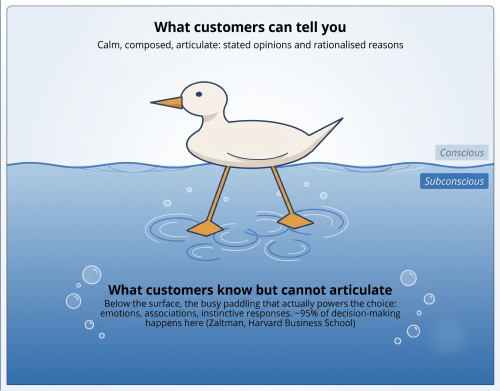
There’s a well-documented limitation in survey-based research which is that people don’t always tell you what they actually think. Not because they’re being dishonest, but because most people genuinely don’t have conscious access to the feelings and associations that drive their behaviour. They give you a considered answer, which can be different to the real situation.
That gap between what people say and what they actually feel is where a lot of research goes wrong. The results look strong, and recommendations seem reasonable but then the outcome is not what was expected. Adding implicit measurement to a standard quantitative study doesn’t make it more complicated or significantly more expensive, it just makes the data more reliable.
If you’re running quantitative market research and want to know what your data is missing, or if you’re starting from scratch and want a research partner who can handle the full picture, we’d be glad to talk through what a study could look like for your brand.
Complete an enquiry form to arrange a meeting with us:

Email marketing is one of those things every brand uses, but very few understand what it actually does to their brand. Some emails feel engaging and

75% of people asked to rate an ad, claim advertising doesn’t affect them.
So what exactly are they rating? And why are we

A Scandinavian TV channel was looking at acquiring broadcast rights across several European football leagues and needed to know which ones were actually