


We talk a lot about the consumer truth gap, which is the gap between what people say they are going to do and how they actually behave. It is also known as the say–do or intention–behaviour gap and it arises from cognitive biases, social desirability effects, and the fact that people often cannot fully articulate their real motivations.
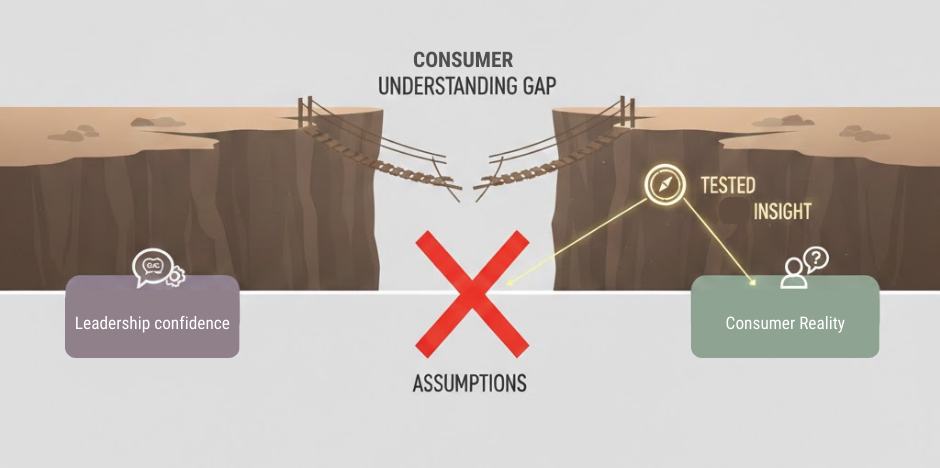
However, there is another gap that exists and gets less attention. This is the truth gap on the business side. It is the gap between how well business leaders believe they understand consumers, and what consumers actually want. This directly shapes the products that get developed and the problems businesses decide to solve.
A lot of businesses make decisions without doing the research. Leaders project their own preferences onto consumers or assume they already know their customers and the problems they have. This is a classic example of overconfidence bias, where confidence in knowledge exceeds the objective accuracy of that knowledge and research has suggested it is common in business leaders (Aren & Hamamci, 2021). When you have been working within a product, category, or organisation for a long time, it is easy to assume you know everything, without realising you are too close to see it from a real customer perspective.
Without measuring what consumers actually want as a solution and how they perceive the problem, you cannot truly understand them. Decisions then become assumption-led and are driven by internal beliefs rather than external evidence from customers.
This gap directly contributes to high product failure rates. Some analyses suggest up to 80% of launches fail to meet objectives, often because of an insufficient understanding of customer needs. Companies invest heavily in solutions based on internal assumptions and only realise the mismatch after launch when adoption is weak.
An example is Amazon’s Fire Phone. The product was built on assumptions about their consumers, including loyalty, demand, and willingness to pay, rather than an understanding of whether their customers would be interested in the product and what they were actually looking for from a smartphone. Amazon assumed that because their customer base was large and engaged, they did not need to explore those needs in depth. The device failed to be adopted and led to losses of more than $170 million, something that data-driven decision-making could likely have prevented.
These types of mistakes, driven by assumption-based decision-making, often lead to costly redesigns and repositioning. To understand consumers properly, businesses need to integrate behavioural observation, implicit measures, and real-world testing, and not just rely on assumptions or stated feedback alone.
But collecting data is only part of the process. Research is not just about gathering information. It is about interpreting consumer reality and turning it into meaningful insight that informs decisions. There is a clear difference between collecting data and creating insight from it, and this is what largely determines the success of research.
How insights are created also matters. When interpretation happens only internally, confirmation bias can easily appear (Bergen & Bressler, 2018). If leaders already hold strong beliefs about what customers want, they may focus on the data that supports those beliefs rather than taking an objective view.
This often happens without people realising, which is why an external perspective can be useful in turning data into unbiased insights.
So next time you assume you know what your customers want, pause and question where that understanding comes from.
Subscribe to our email newsletter to keep up to date with our latest insights, news, and findings on market research, implicit testing and our occasional psychological ‘neuro-nuggets’ of wisdom.
Our insights-led team focuses on turning data into consumer understanding, by providing strategic recommendations and direction depending on the client’s business challenges.
Please dial all digits from anywhere in the world, including the UK
London address:
1 Kingdom Street, Paddington, London, W2 6BD
References:
Aren, S., & Hamamci, H. N. (2021). Biases in managerial decision making: overconfidence, status quo, anchoring, hindsight, availability. Journal of Business Strategy Finance and Management, 3(1-2), 8.
Bergen, C. V., & Bressler, M. S. (2018). Confirmation Bias in Entrepreneurship. Journal of Management Policy and Practice, 19(3). https://doi.org/10.33423/jmpp.v19i3.49
We are pleased to announce a strategic partnership between Split Second Research (UK) and On-Target Marketing Solutions for Asia-Pacific.
Dr. Salim Khubchandani, who leads On-Target Marketing Solutions

We talk a lot about the consumer truth gap, which is the gap between what people say they are going to do and how
Many of our clients have built up a rich body of research over time. A common question we hear is how to get more value
Subscribe to our email newsletter to keep up to date with our latest insights, news, and findings on market research, implicit testing and our occasional psychological ‘neuro-nuggets’ of wisdom
Please enter your details
You can unsubscribe anytime. For more details review or Privacy Policy.