CASE STUDY

Tagline Testing for a Bank in Singapore

The Challenge

OCBC wanted to show its customers, and potential customers, that it really understands their needs. The task was to develop a tagline that felt authentic, believable, and memorable.

But words that sound good on paper don’t always connect with brains in the way a brand hopes. The client needed to understand not just what people said they liked, but how their brains responded to each option.  These are responses they might not be able to articulate.

The Solution

To get a deeper view, Split Second Research used neuro-cognitive techniques to test sixteen potential taglines across three rounds: six in the first, five in the second, and five in the third.

Each set was compared against taglines from two competitor banks and a global benchmark, Singapore Airlines’ A great way to fly, giving a clear reference for how well each option resonated.

The Outcomes

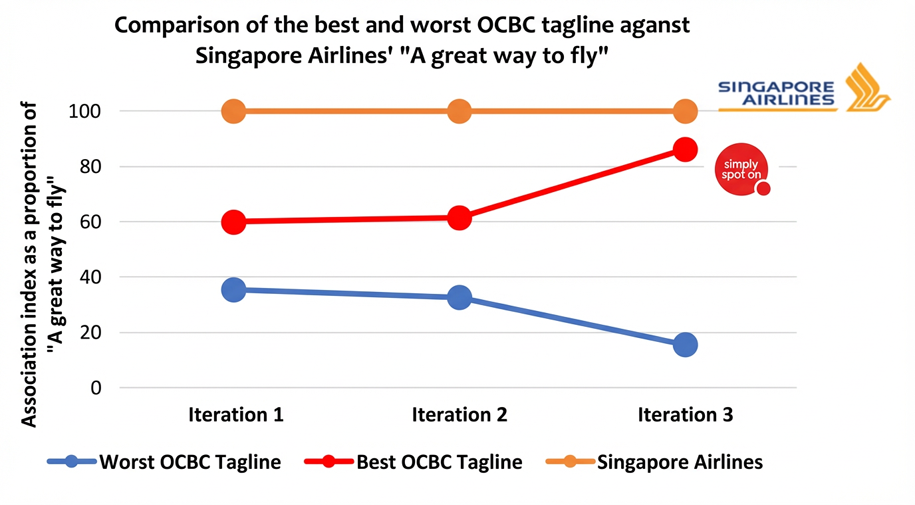
The first set of taglines didn’t perform well. Even the strongest scored only 60% of the benchmark (A great way to fly). The second round showed that the design route was still in the wrong direction as there was only a very small improvement. 

By the third round, the team had a much clearer understanding of what customers responded to. This led to a tagline that clearly conveyed OCBC’s brand promise and felt authentic to both existing and potential customers.

ocbc bank chart

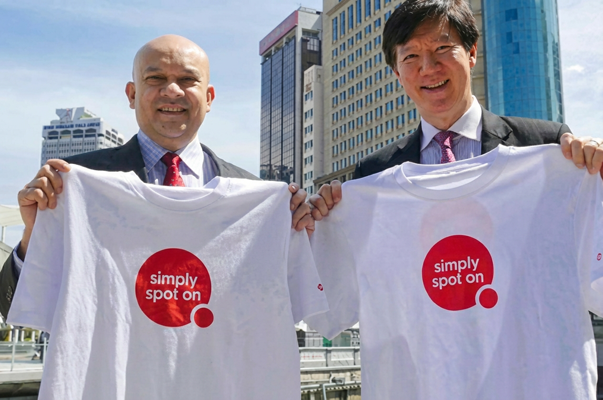
This case shows that testing beyond what people say can make a real difference. Traditional research alone might have suggested that some taglines were good enough. It is only by looking at how people really reacted could OCBC find the option that was “spot on” in practice.

NewOCBCLogo

OCBC ended financial year 2018 with a record net profit of $4.49 billion Singapore dollars ($3.31 billion), despite the challenging market conditions.

If you’d like to understand how this approach can be applied to your own challenge, get in touch with one of our market research experts, here.

Case Studies

Understanding Emotional Responses to Fragrance in Context
Fragrance in context

Understanding Emotional Responses to Fragrance in Context

A global fragrance company wanted to profile how four new fragrances were experienced, with a specific focus on their functional emotional use.
The goal was to understand which fragrances naturally support different emotional states, for example, which scents help calm or reduce anxiety in work environments, and which feel more appropriate in contexts requiring reassurance or comfort, such as high-trust or service-led settings.
This introduces a more

Read More
celebrity tv partner match
Celebrity & TV Sponsorship Fit

Finding the Right Fit: Why Brand and Partner match matters

Picking the right partner for a brand, whether that’s a celebrity or a sponsor, is harder than it looks. High profile and well-liked doesn’t automatically mean the right fit, and a mismatch can do real damage to a brand even when it’s not immediately obvious why.
Two clients came to us with versions of

Read More
Scroll to Top