CASE STUDY

Strengthening Brand Identity 
Through Scent and Visuals

Strengthening Brand Identity Through Scent and Visuals

The Challenge

When a fragrance design company was commissioned to develop a new scent for a fabric conditioner, the brief quickly expanded beyond the fragrance itself.

The client wanted to refine the formula and refresh the imagery used in marketing materials at the same time. The challenge was understanding how these elements worked together. A fragrance that performs well on its own can lose impact if it is paired with the wrong visuals, and updated imagery can underperform if it doesn’t reinforce the feeling of the scent.

What the client needed was clarity on which combinations created a clear, distinctive identity, and which ones risked blurring the brand with competitors.

The Solution

Using our IMPRESS tests, we tested a mix of existing fragrances, competitor scents and new formulations alongside both current and new marketing images.

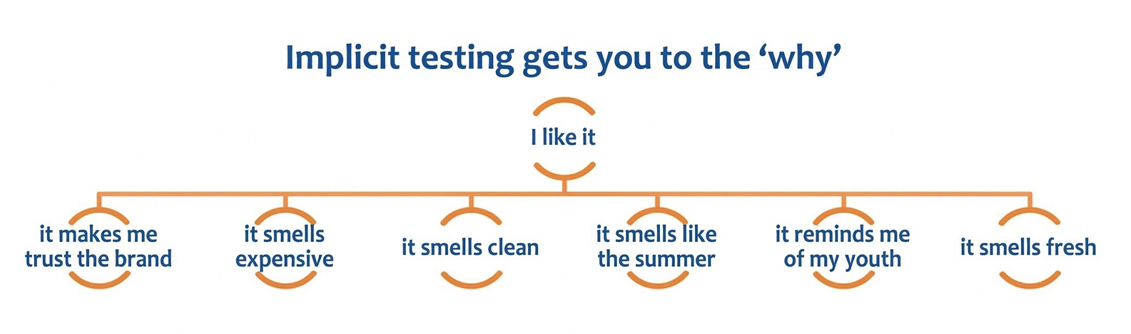
We explored how people instinctively linked scent and imagery, rather than asking them to rationalise those connections. This made it possible to see where associations were strong and coherent, and where there was overlap or confusion.

The Outcomes

The results showed that the client’s existing imagery wasn’t helping the brand stand apart. While the images were positively associated with the client’s current fragrance, they were also strongly linked to a competitor’s scent, limiting their ability to differentiate the brand.

The new visuals formed much stronger and more exclusive associations with the new fragrance formulations. One new formula in particular aligned strongly with three of the four new images, pointing to a clearer and more distinctive identity when scent and imagery were paired correctly.

Additional analysis using EEG found that two attributes correlated strongly with EEG liking. One image stood out for producing particularly strong contrast in response, making it easier for consumers to recognise and react to at an instinctive level.

Together, this gave the client confidence in which fragrance–image combinations created a coherent, ownable identity, and which elements were quietly undermining it.

In this case, traditional research alone would have missed how the existing images were also reinforcing competitor perceptions, reducing differentiation for the brand.

If you’d like to understand how this approach can be applied to your own challenge, get in touch with one of our market research experts, here.

Case Studies

Understanding Emotional Responses to Fragrance in Context
Fragrance in context

Understanding Emotional Responses to Fragrance in Context

A global fragrance company wanted to profile how four new fragrances were experienced, with a specific focus on their functional emotional use.
The goal was to understand which fragrances naturally support different emotional states, for example, which scents help calm or reduce anxiety in work environments, and which feel more appropriate in contexts requiring reassurance or comfort, such as high-trust or service-led settings.
This introduces a more

Read More
celebrity tv partner match
Celebrity & TV Sponsorship Fit

Finding the Right Fit: Why Brand and Partner match matters

Picking the right partner for a brand, whether that’s a celebrity or a sponsor, is harder than it looks. High profile and well-liked doesn’t automatically mean the right fit, and a mismatch can do real damage to a brand even when it’s not immediately obvious why.
Two clients came to us with versions of

Read More
Scroll to Top