
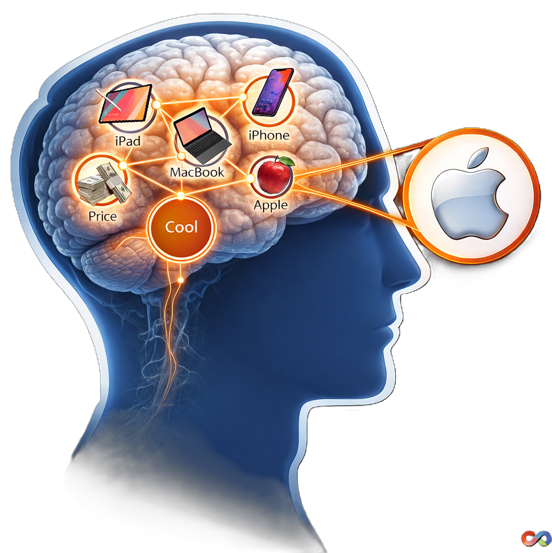

Every year, thousands of new products launch on the back of research that said they would succeed. Concept tests came back positive. Focus groups nodded along. Survey respondents said, yes, I would buy that. And then the product hits the shelf and quietly disappears
The industry has long quoted new product failure rates of 70 to 90 percent, depending on the category. Harvard Business School’s Gerald Zaltman puts the figure at around 80 percent of new products failing within six months or falling well short of forecast, and Harvard Business Review’s widely cited analysis, Why Most Product Launches Fail, reaches similar conclusions. What is remarkable is not the failure rate itself. It is that so many of these products were “validated” by research before launch.
So what went wrong? In most cases, nothing went wrong with the customers. Something went wrong with the questions.
Here is the uncomfortable truth about traditional market research: it assumes people can accurately report why they do what they do. Ask someone why they chose a brand, what they think of a new concept, or whether they would buy a product, and they will give you an answer. A sincere, considered, articulate answer.
The problem is that sincerity is not the same as accuracy.
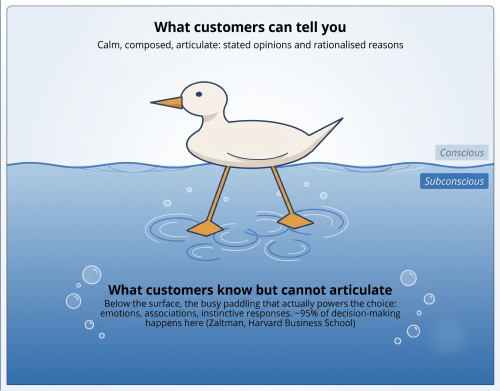
Decades of research in cognitive psychology, from Nisbett and Wilson’s classic 1977 paper Telling More Than We Can Know onwards, has shown that people have surprisingly limited access to the real drivers of their own behaviour. The processes that shape our preferences, emotional responses, associations, gut feel, learned cues, run largely beneath conscious awareness. When we are asked to explain our choices, we do not retrieve the true cause. We construct a plausible story after the fact. Zaltman estimates that 95 percent of purchase decision-making takes place in the subconscious mind, far beyond the reach of a direct question.
Your customers are not lying to you. They simply don’t know what they know.
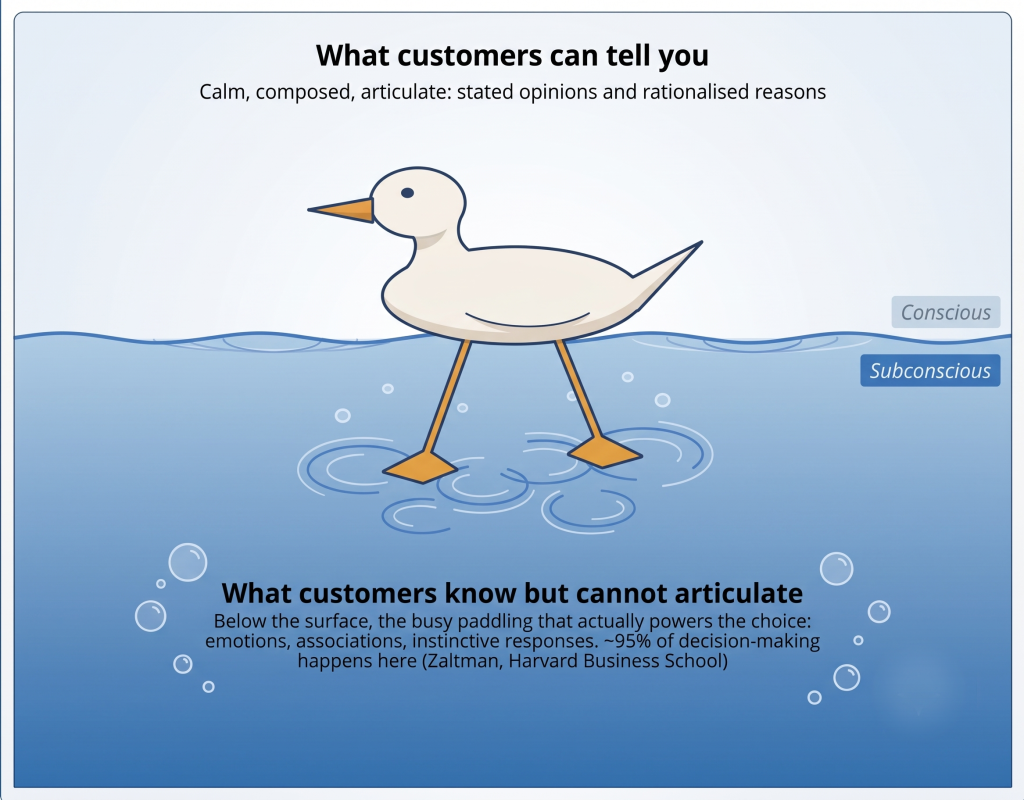
Figure 1. Like a duck on water: calm and composed on the surface, paddling furiously below. The real work of decision-making happens out of sight.
You have probably experienced this yourself. Someone describes a feeling or a motivation you could never quite put into words, and you think, yes, that’s exactly it. You recognised it instantly, but you could never have generated it on demand. That is the introspection gap in action: we are far better at recognising truths about ourselves than articulating them.
Direct questioning does not just miss the deeper drivers. It actively distorts the picture, in predictable ways.
People rationalise. Asked to justify a preference, respondents reach for reasons that sound sensible: price, quality, convenience. The emotional and associative drivers that actually moved them rarely make it into words.
People perform. In a focus group or survey, respondents want to be helpful, consistent and reasonable. “Would you buy this?” invites a socially agreeable yes far more often than the shelf does.
People deliberate when real life doesn’t. A survey gives someone thirty seconds to consider a pack design that will get a third of a second of attention in a supermarket aisle. The slow, considered response measured in research bears little resemblance to the fast, instinctive response that decides the sale.
New Coke remains the textbook case. The reformulated recipe was preferred in taste tests of nearly 200,000 consumers, because sip tests measure a conscious, deliberate evaluation. What those tests could not measure, as Coca-Cola itself now acknowledges, was the deep emotional bond consumers felt with the original brand, an attachment those same consumers would never have articulated in a survey, and one that surfaced with full force only after launch. Within 79 days the original formula was back on the shelves.
This is the gap Split Second Research was built to close. Rather than relying on what people report, we use objective measures: methods that record what people actually do and how they genuinely respond. These range from implicit response techniques to biometric measures such as eye tracking, facial expression analysis and physiological arousal, capturing the reactions that occur before conscious deliberation gets involved.
Implicit response testing illustrates the principle. The speed and pattern of a person’s response to a brand, a pack, a fragrance or a claim reveals the strength of the underlying association, before the rational mind has had a chance to construct a tidy explanation. Milliseconds of hesitation carry information that an hour of discussion cannot reach. Biometric measures add further objective layers: where the eyes go first, how expressions shift, how the body responds, none of which depends on a respondent finding the right words.
Our BRAIN Model brings these layers together: what people do (Behaviour), what they say (Rational), what they feel (Affective), what they intend (Intention) and the network of associations their fast, automatic responses reveal (Neural Network). Direct questioning captures only the rational layer, the calm surface of the water. Real predictive power comes from measuring all of them, and understanding where they agree and where they diverge.
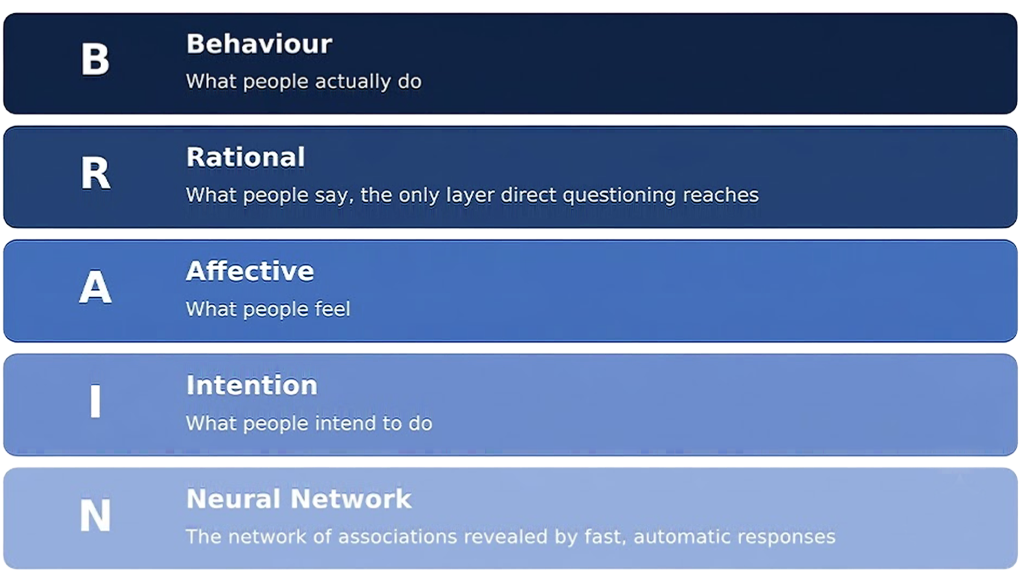
Figure 2. The BRAIN Model. Direct questioning reaches only the Rational layer; objective measures unlock the rest.
Because that divergence is the insight. When stated opinion and objective measures line up, you can launch with confidence. When they pull apart, you have found exactly the risk that traditional research would have missed, before it costs you a failed launch.
None of this means consumers are unknowable, or that asking questions is worthless. It means the opposite: your customers hold far more insight than conventional research ever extracts. The knowledge is there. It just lives deeper than words.
The brands that consistently launch winners are not the ones with more survey data. They are the ones measuring what their customers know but cannot say.
Split Second Research has spent over 15 years helping brands including Shell, Boots, Johnson & Johnson and Chanel understand the drivers of consumer behaviour that direct questioning cannot reach. Our Deeplight platform makes objective research methods fast, scalable and accessible. If you would like to see what your customers know but can’t tell you.
No spam. Your details are confidential.
Please call:
+44 20 4534 7458
Please dial all digits from anywhere in the world, including the UK
London address:
1 Kingdom Street, Paddington, London, W2 6BD
Nisbett, R. E. and Wilson, T. D. (1977). Telling More Than We Can Know: Verbal Reports on Mental Processes. Psychological Review, 84(3), 231-259. psycnet.apa.org/record/1978-00295-001
Zaltman, G. (2003). How Customers Think: Essential Insights into the Mind of the Market. Harvard Business School Press. Interview: The Subconscious Mind of the Consumer (And How to Reach It), HBS Working Knowledge. library.hbs.edu/working-knowledge/the-subconscious-mind-of-the-consumer-and-how-to-reach-it
Schneider, J. and Hall, J. (2011). Why Most Product Launches Fail. Harvard Business Review, April 2011. hbr.org/2011/04/why-most-product-launches-fail
The Coca-Cola Company. New Coke: The Most Memorable Marketing Blunder Ever? coca-colacompany.com/about-us/history/new-coke-the-most-memorable-marketing-blunder-ever
Encyclopaedia Britannica. New Coke: History, Response and Facts. britannica.com/topic/New-Coke
Kahneman, D. (2011). Thinking, Fast and Slow. Penguin. A general-audience account of the fast, automatic (System 1) and slow, deliberative (System 2) thinking that underpins implicit and other objective research methods.
Subscribe to our email newsletter to keep up to date with our latest insights, news, and findings on market research, implicit testing and our occasional psychological ‘neuro-nuggets’ of wisdom.
Six years ago we created a comic strip about a couple trying a free product sample at a shopping centre. At the

Every year, thousands of new products launch on the back of research that said they would succeed. Concept tests came back positive. Focus groups nodded along. Survey respondents said,
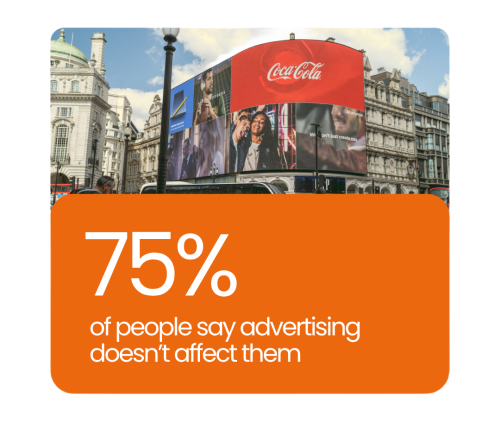
75% of people asked to rate an ad, claim advertising doesn’t affect them.
So what exactly are they rating? And why are we
Subscribe to our email newsletter to keep up to date with our latest insights, news, and findings on market research, implicit testing and our occasional psychological ‘neuro-nuggets’ of wisdom
Please enter your details
You can unsubscribe anytime. For more details review or Privacy Policy.