
What is an Implicit Association Test?
A guide for brand managers and insight managers
Published by Split Second Research
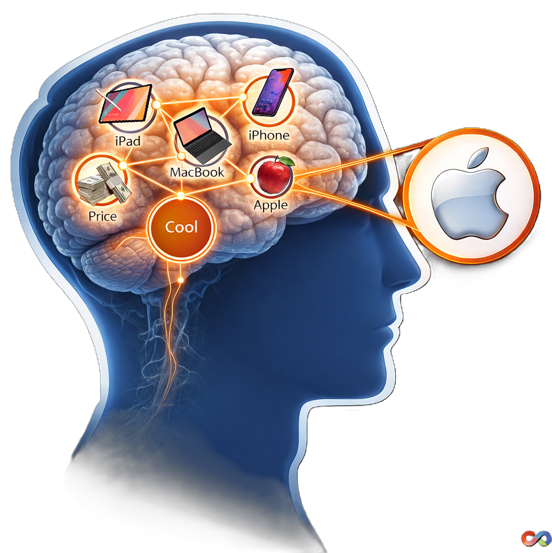
This guide is written for brand managers, consumer insight professionals, and marketing directors who want to understand what implicit association testing is, why it matters, and how it compares to traditional research methods. It draws on established cognitive psychology, neuroscience, and our own extensive body of applied research. By the end, you will have a clear picture of the science behind the method, why it produces more reliable predictions of real consumer behaviour, and how Split Second Research applies it across the full range of brand and marketing challenges.

Why can’t you just ask consumers what they think?
On the surface, asking people what they think seems perfectly reasonable. But decades of psychological research, and our own empirical work, show that what people say and what they actually do are often two very different things. This is known as the truth gap. It presents a significant and largely under-appreciated risk in market research. The problem is not dishonesty. Most respondents genuinely try to give accurate answers. The problem is that a great deal of what drives consumer behaviour happens below the level of conscious awareness, in fast, intuitive, automatic mental processes that people simply cannot access when asked to reflect and respond.
Think of the time when you or someone you know, made a commitment to a diet. You or they genuinely believed the diet would be adhered to. Yet the vast majority abandon it within days or weeks. There weren’t being dishonest about their intent. The intention was genuine and rational. But the behaviour wasn’t. Responses to food cues are habitual, emotional, and operate below conscious awareness. Behaviour is mostly driven this way.
What exactly goes wrong in a traditional survey?
There are at least nine well-documented ways that self-report surveys can produce unreliable data:
- Respondents present themselves favourably, rather than truthfully, especially when questions touch on identity or social and cultural norms.
- People are only consciously aware of broad, generalised feelings, not the nuanced, specific attitudes that really drive their choices.
- Because of this, respondents often overgeneralise. They rate everything about a brand positively (or negatively) based on a single dominant impression.
- People try to appear consistent, producing responses that look rational and coherent but may not reflect the genuine complexity of their attitudes.
- Respondents may feel obliged to give positive, brand-friendly answers, particularly when they are being paid to participate.
- People sometimes deliberately conceal how they feel, for privacy reasons, social reasons, or for no reason they can articulate.
- Self-knowledge is often constructed after the fact. When asked why they made a decision, people generate plausible explanations rather than retrieving the true cause.
- Some respondents, motivated to complete a survey quickly, give near-random answers to finish faster.
- Feelings and attitudes can simply be very difficult to put into words. Most people are not skilled at verbalising subtle emotional responses.
What all of these problems share is that their responses in the survey are uncontrolled. A respondent can answer in any way they choose, regardless of their genuine attitudes. Add these sources of noise together across a sample and the result might be data that discriminates poorly, giving a false answer to the research question. Drawing confident conclusions from such data about your market category, your brand, competitor brands, design routes, claims and taglines, new products concepts and so on, would be significantly risky.
The idea of the ‘rational consumer’, someone who consciously weighs costs and benefits and selects the option that maximises their utility, has shaped market research methodology for decades. But contemporary psychology and neuroscience have substantially undermined this model.
Research shows that most purchasing decisions, including everyday shopper decisions, are strongly influenced by non-conscious and intuitive processes. The rational model ignores a vast and powerful set of influences that people find difficult to verbalise or even to be consciously aware of. A methodology built entirely on rational self-report is therefore measuring only a fraction of what actually drives behaviour.
What is System 1 and why does it matter to marketers?
Cognitive psychologists have long described the mind as operating through two broad modes of processing. System 1 is fast, automatic, and non-conscious. It runs in the background continuously, making split-second evaluations of everything we encounter: faces, objects, environments, brands. System 2 is slow, deliberate, and conscious. It is what we use when we think carefully through a decision.
System 1 is evolutionarily ancient, and most mammals operate this way. System 2, the capacity for slow, deliberate, reflective thought, is a much more recent evolutionarily and is, for all practical purposes, uniquely human.
But the crucial insight is that System 1 is not a secondary, background process, it is the dominant one. Most of what we do, including most purchasing behaviour, is shaped by System 1. Yet because System 1 operates below conscious awareness, it cannot be directly accessed through System 2 introspection. When someone in a survey explains their brand preference, they are typically generating a post-hoc rationalisation, which is a System 2 story about a System 1 decision!
What does ‘automatic evaluation’ mean in practice?
Almost everything we encounter (object, brand, person, or situation) is ‘value charged’, meaning that it provokes an immediate, involuntary emotional reaction. This automatic, split-second evaluation happens before any conscious deliberation. Yet it influences behaviour. Neuroscientists have identified a structure deep in the brain, known as the amygdala, that processes emotional and biological significance, before the conscious mind has had chance to catch up. It learns to assign experiences with an emotional tag. Crucially, it is part of System 1.
It is activated most commonly in social judgements and first impressions. For example, deciding within seconds whether someone is trustworthy. We might be wary of someone without being able to explain why. Another context is perception of risk and safety. We instantly step back from a loud noise, feel uneasy walking down a poorly lit street, or slowing down when something “feels off” when driving. Another is in our aesthetic preferences, our likes and dislikes. We may be drawn to certain colours, shapes, layouts, and having global feelings of comfort or discomfort without being able to articulate why.
It’s the same with brands and products. We can prefer one brand over another because it just “feels right” and without being able to explain it clearly. The moment a consumer sees a product, a logo, a piece of packaging, or an advertisement, evaluations are triggered automatically. These are shaped by every previous experience the consumer has had with the brand, from direct experience to advertising exposure, social influence, and word of mouth. They are stored in memory as associations, and they surface as feelings: a sense of trust, a sense of excitement, a sense of reassurance (or their opposites).
In everyday language we recognise this: we talk about a brand having ‘a certain something’, about ‘gut reactions’, about intuitions we can’t quite articulate. These are not vague impressions, they are real cognitive states, and they drive real behaviour.
Think of brands like Rolls-Royce, Rolex, Goldman Sachs, and Harley-Davidson. For most people, what they associate with these brands is formed almost entirely through indirect exposure (advertising, cultural presence, what others say, media exposure, and so on). Your amygdala and associative memory system have filed away strong feelings about a Rolls-Royce even if you’ve never sat in one. That’s a powerful argument for why implicit testing captures something real that surveys can miss.
Where do brand associations come from?
Our understanding of how the brain stores and retrieves knowledge is based on associative memory networks. The idea, with roots going back to Aristotle and built on by decades of psychology and, more recently, by neuroscience and the learning mechanisms in AI systems, is that concepts in memory are linked by association.
When one concept becomes active, say, seeing a brand logo, it activates related concepts through a process called ‘spreading activation’. Strongly associated concepts may become consciously accessible (you might think ‘reliable’ or ‘stylish’). Other associated concepts may only be activated at a subconscious level, influencing your response without your awareness.
This is the neural basis for how brands work emotionally. A brand’s meaning, in cognitive terms, is the network of associations attached to it. Those associations, some related to the product’s features and some to how it makes them feel, are the target of implicit testing.
Are intuitive, subconscious (System 1) responses always correct?
No — System 1 processing is not inherently logical, nor does it reliably serve an individual’s best interests. That said, whether it is “correct” depends heavily on context.
For procedural and physical tasks, such as walking, talking, playing a sport or musical instrument, System 1 is remarkably well-optimised. These processes allow us to perform complex actions fluently, without conscious deliberation. In these domains, System 1 excels.
However, in the realm of judgment and decision-making, System 1 is far more fallible. It is the primary source of cognitive biases: systematic errors in thinking that arise from mental shortcuts and automatic associations. System 2, our slower, more analytical mode of thinking, is theoretically responsible for catching and correcting these errors, but it frequently fails to do so. This is because engaging System 2 requires conscious effort, attention, and motivation, all of which are limited resources.
From a consumer behaviour perspective, the more important question is not whether System 1 is logical, but how influential it is. The reality is that most consumer decisions are driven by System 1 processes, and are therefore susceptible to cognitive biases. Understanding this is essential, because if we want to understand why people make the decisions they do, we must understand the system that is generating those decisions in the first place.
What evidence is there that most consumer decisions originate in System 1?
Academic research, where issues evidence are debated, suggests that the majority of consumer decisions are driven by System 1 processes (Zaltman, 2003; Kahneman, 2011). While the precise proportion is questioned, the broader point that automatic, unconscious processing plays a dominant role in consumer behaviour is well supported.
Some examples:
- In-store purchases. Most supermarket purchases are made on autopilot. Studies suggest shoppers make most purchase decisions in the aisle, in seconds, and split seconds, based on familiarity, packaging, and brand recognition rather than deliberate evaluation (this is consistent with Point of Purchase Institute research).
- Brand associations. When someone reaches for Heinz ketchup without considering alternatives, that is System 1 at work. Habitual choice driven by familiarity and emotional association, not rational comparison.
- Pricing perception. The widespread effectiveness of £9.99 vs £10.00 pricing only works because consumers don’t stop to consciously interrogate it. System 2 would see through it immediately. Similarly anchoring works because System 2 is ‘lazy’ – for example, a well-known store offers three different shower systems, a luxurious model at a high price, a basic model at a lower price, and a mid-range model in between. The middle one outsells the luxury and basic ones 20 to 1. System 1 gravitates towards it as the “safe”, reasonable choice, without consciously evaluating whether the mid-range price actually represents good value.
- Advertising. Many people claim that advertising does not work on them, that they are impervious to it. What they may not realise is that much of what makes advertising effective operates below conscious awareness, emotional tone, music, colour, and imagery shape brand perception without people realising it. Byron Sharp’s How Brands Grow (2010) and work by the Ehrenberg-Bass Institute support this strongly. Juts to add that the scale of investment brands make in advertising is itself telling: global ad spend exceeded $1 trillion for the first time in 2024. If advertising did not work, rational commercial actors would not continue to pour money into it.
- Impulse buying. By definition, impulse purchases involve no deliberation. They are triggered by cues in the environment activating automatic responses. Work by Baumeister (2002) on ego depletion showed that willpower and self-control are finite resources. The more decisions people make, the more likely they are to default to impulsive, unconsidered choices later. This is sometimes called “decision fatigue.” The fact that retailers deliberately engineer environments to trigger impulse purchases, is itself powerful real-world evidence that consumers often make impulse purchases.
How many emotions can a brand evoke?
Much traditional neuromarketing focuses on five basic emotions: joy, sadness, fear, disgust, and surprise. But in the social and commercial world, the emotional landscape is far richer and more nuanced than this.
Brands can make consumers feel hopeful, contented, rewarded, nostalgic, trusted, stimulated, reassured, aspirational, guilty, proud, and thousands of other states. They satisfy both functional and emotional needs, and consumers can hold contradictory feelings about the same brand simultaneously. Measuring only five emotions, or only a simple like/dislike dimension, misses most of what is genuinely going on.
This is one of the key reasons we believe implicit association testing goes further than other neuromarketing methods. It can map 30, 40 or more highly specific emotional and attitudinal associations about a brand.
How many emotions can a brand evoke?
An implicit association test (IAT) is a reaction-time based method that measures the strength of association between concepts in memory, without asking respondents to evaluate anything directly. Instead, it exploits a fundamental property of the associative memory system: when two concepts are strongly linked in memory, the mind can process them together more quickly than when they are weakly linked or unrelated.
The test presents respondents with a series of rapid stimuli, such as brand names, images, or words, and measures how quickly they can categorise or respond to them. Unlike a standard survey question, where respondents choose their own answers, there is an objectively correct response to each item. The key insight is in the act of categorising stimuli, respondents inadvertently reveal how they feel about them, without ever being asked for an evaluation. The response latencies (reaction times) reveal the underlying associative structure that drives their attitudes and feelings, bypassing the conscious reporting system entirely.
How does affective priming work — the method at the heart of IMPRESS?
Our proprietary platform DeepLight, uses a variant of implicit testing called affective priming.
A ‘prime’ is presented to the respondent. This might be a brand logo, an image, or a specific word representing an emotional attribute. Immediately after, a target word or brand name appears and the respondent simply has to identify it as quickly as possible by pressing a key.
The critical measurement is the time taken to identify different kinds of targets. These differences in reaction time, measured across many trials and many respondents, reveal with statistical precision how strongly each attribute is associated with each brand. Respondents are not asked to evaluate anything. Most have no idea what is being measured. The test is therefore extremely difficult, often impossible, to fake.
Is the test really measuring something unconscious?
Yes, and the evidence for this is robust. Studies have shown that affective priming effects persist even when primes are presented subliminally, that is, too quickly for respondents to consciously perceive them. The associations being tapped are not what the respondent consciously thinks about a brand, they are what their memory system has actually encoded.
More broadly, the psychological evidence for unconscious influences on behaviour is substantial. Research in anaesthesia has shown that words presented to patients under general anaesthetic can later influence their responses to word completion tasks. Research on motor skills shows that skilled practitioners cannot verbalise the precise knowledge that underlies their performance. The knowledge exists, but it is below the threshold of conscious access.
The global workspace model of consciousness, one of the leading frameworks in cognitive neuroscience, provides a structural explanation for why this is so. Conscious awareness has capacity limits and can only access information that reaches the central workspace. Much of the information in memory (including many brand associations) exists below this threshold and is accessible only through indirect, implicit methods.
Does the evidence actually show implicit measures are better predictors of behaviour? When are they better predictors?
Yes, and for a recent academic review of implicit association tests in the context of consumer behaviour, see the special issue in the Journal of Retailing and Consumer Services edited by Rezai (2021) Beyond explicit measures in marketing research: Methods, theoretical models, and applications
Below are some highlights from our own review across a substantial body of peer-reviewed research:
- Steinman and Karpinski (2009) found that implicit, but not explicit, attitudes towards the brand GAP predicted actual GAP patronage and purchase intentions.
- Brunel, Tietje and Greenwald (2004) showed that implicit methods detect brand attitude differences that explicit measures cannot — including the effects of different consumer demographics on brand preference patterns.
- Priluck and Till (2009) found that while explicit and implicit measures were equally good at detecting large, obvious differences between brands, only implicit measures could reliably detect subtle differences.
- Chan and Sengupta (2010) found that when respondents consciously dismissed the claims of an advertisement, their implicit responses revealed that the ad had nonetheless produced favourable brand attitudes.
- Vianello, Robusto and Anselmi (2010) demonstrated that implicit measures of personality traits were essentially unaffected by deliberate faking attempts, while explicit measures shifted significantly.
- The theoretical logic is strongest for habitual, low-deliberation purchases. For low-involving products, attitudes are only weakly developed cognitively, being based primarily on feelings related to brand image and brand personality rather than elaborated reasoning.
- In those conditions, reaction-time measures that tap into associative memory are arguably capturing the actual decision process more faithfully than a questionnaire asking someone to consciously reflect on it.
- Decisions on purchases with long-term consequences, such as buying a car, are more prone to cognitive, rational influences than they are to implicit processes, although the latter still have a role to play. For example, in a recent study, Altenburg and Spruyt (2024) showed that implicit responses are sensitive to price labelling and so it is an unbiased way of measuring how much consumers are willing to pay for goods and services, even premium ones.
Split Second Research also holds a substantial body of unpublished proprietary data consistent with these findings. In our studies, active brand customers consistently produce stronger and more positive implicit profiles than lapsed or rejecting customers. Fans of a particular genre show strong positive implicit responses to relevant stimuli where non-fans show strongly aversive responses. Brand positioning studies repeated three months apart show high correlation in implicit profiles, demonstrating that in consumer research, the method has real test-retest stability as well as predictive validity.
Why is it so hard to fake an implicit test?
Traditional surveys are inherently gameable. A respondent who wants to present a particular image of themselves, or who simply wants to get through the test quickly, can do so easily, there is no constraint on what answer they give.
An implicit test is different. Each trial has a correct response, and the measure is not which response the respondent gives but how quickly they give it. A respondent cannot deliberately slow or speed their reaction times in a controlled way across dozens or hundreds of trials. Even if they wanted to distort the result, they would need to know which associations are being measured and in which direction, something the design of the test carefully conceals.
Some have questioned whether reaction-time based measures truly qualify as ‘implicit’ in the strictest sense, for instance, whether respondents might be aware that their attitudes are being assessed. This is a legitimate academic debate, and different methods sit at different points on a spectrum from fully explicit to fully implicit. What is clear from the empirical evidence, however, is that whatever we call them, these methods significantly outperform explicit surveys on the criteria that matter most to brand managers: predictive validity, resistance to faking, and sensitivity to subtle attitudinal differences.
What can you actually find out from an implicit association test?
An implicit test can tell you, with granular precision, which emotional and attitudinal attributes consumers associate with your brand, and with what strength. Unlike a simple like/dislike scale, or a five-emotion neuromarketing panel, it can map dozens of specific associations simultaneously. When combined with explicit measures, which tap rational and subjective attitudes, the two can provide a powerful model of market drivers.
This means you can understand not just whether consumers like your brand, but why: What it makes them feel, what needs it satisfies, what functional and emotional dimensions it occupies in the consumer’s mind. And crucially, you can do the same for your competitors, identifying where your brand is strong, where it is vulnerable, and where genuine positioning opportunities exist.
Across which touchpoints is implicit testing applicable?
Implicit testing is applicable across the full consumer journey. At Split Second Research, we apply it to:
- Brand equity and positioning: understanding the associations consumers hold for your brand versus competitors, and identifying where the real opportunities are in your category.
- Packaging testing: measuring how designs perform on emotional response, standout, and findability before costly production decisions are made.
- Brand tracking: monitoring how brand perception shifts over time and in response to marketing activity, with a level of sensitivity that explicit tracking cannot match.
- New product development: applying insight at the development stage to reduce the risk of costly launches.
- Pricing and promotions: understanding how price points and promotional mechanics affect brand perception, not just stated purchase intent.
- Product claims: measuring how consumers genuinely respond to each claim, beyond what they consciously report.
- Advertising testing: assessing the emotional impact of creative executions, and whether they are doing what they are supposed to do.
- Market category analysis: understanding the purchase drivers across a category before diving into individual brands.
The common thread is that implicit testing is applicable wherever the gap between what consumers say and what they actually feel poses a risk to decision-making, which, in our experience, is almost everywhere.
Across which market categories is implicit testing applicable?
Implicit testing has been used by Split Second Research to test a broad range of categories, including:
Food Retail: Supermarkets, convenience stores, dairy products, soft drinks from bottled water, to juices, to sweet drinks), alcoholic beverages, ice-cream, biscuits, coffee, breakfast tea, green tea, children’s milk products.
Wellbeing: Gym use, minerals & supplements, skin conditioning, haircare, nicotine substitutes, perfume, oral care, soap, nappies / diapers designs, cosmetics, hand sanitizers.
Medical: Private health care, cosmetic surgery, eye care, pharmaceuticals (perception of treatments and claims in medical practitioners).
House and Home: Room fragrance, home security, home cleaning & disinfectants, air sanitisers, drain and sink unblockers.
Professional services: Training, Implementing change in the workplace, mental health in the workplace, IT technical services.
Financial Services: Wealth management, foreign exchange, high street banking, health insurance, insurance brokerage, digital banking and all aspects of fintech, online comparison services.
Transport: In-vehicle technology, standard vs high grade fuel, new vehicle models.
Media: Sponsorship in televised sport, TV sponsorships in general, TV station promos, TV and movie trailers, perception of TV companies.
Lifestyle: Casual dining, fast food, computer games, holiday homes, clothing, shoes and footwear, bars and restaurants, holiday destinations, over-the-counter contraceptives, music, solar energy in the home, women’s issues in the workplace, travel agency.
Public Relations Research: A host of different projects looking at social biases, health issues, responses to leisure and consumer activities, responses to food.
What is IMPRESS and how is it different?
IMPRESS is Split Second Research’s proprietary implicit testing solution. It is built on affective priming methodology and the associative network theory described in this guide, developed and refined over many years of applied research and validated against real-world behaviour.
What makes IMPRESS distinctive is its depth and flexibility. We are not limited to measuring a handful of standard emotional dimensions. We can design tests around 30, 40 or more specific attributes tailored to the research question at hand: Functional attributes, emotional attributes, brand personality dimensions, and more.
The platform also integrates explicit and implicit measurement. Because we run our untimed explicit questions prior to the implicit phase, we can map what consumers consciously associate with a brand alongside what they associate with it subconsciously, producing a complete picture of the brand’s emotional and attitudinal profile, and revealing any significant gaps between the two.
How do respondents experience the test?
The test is simple and brief for respondents. They see stimuli on screen and respond by pressing keys. There are no questions to answer, no scales to fill in, and no evaluations to make. Most respondents find it engaging rather than burdensome.
Crucially, the design of the task means respondents genuinely do not know what is being measured. They cannot game the results, even if they wanted to. The data collected reflects what is actually stored in their memory, not what they choose to reveal.
Isn’t all this just academic theory? Does it work in practice?
This is the right question to ask. The evidence base for implicit association testing is not merely theoretical, it spans decades of peer-reviewed research across psychology, consumer science, and neuroscience, as well as a substantial body of applied commercial research.
At Split Second Research, our work has been validated by real-world outcomes, recognised by industry awards, and trusted by major brands across multiple categories. We have observed consistent patterns: implicit profiles that predict brand choice and loyalty, that reveal attitudinal differences invisible to explicit research, and that remain stable over time, demonstrating the reliability of the method.
Don’t neuroscientific methods like fMRI and EEG do the same thing?
Neuromarketing encompasses a wide range of tools: brain scanning (fMRI), EEG, biometrics such as heart rate and electrodermal response, facial coding, eye-tracking, and reaction-time based tests (all methods in bold are services Split Second research offers). Each captures a different aspect of the consumer’s response.
Brain scanning can indicate the strength of a response, EEG can capture gross patterns of brain activity, biometrics measure the physiological components of an emotional reaction, and facial coding reveals global emotional state. Each has strengths and weaknesses.
However, we contend that implicit association testing goes deeper than most of these methods on the dimension that matters most to brand managers: the specific emotional and attitudinal content of what consumers feel about a brand. Most other neuromarketing methods measure whether a consumer is responding emotionally, and perhaps how strongly. Implicit association testing measures what they feel and with a granularity of 30, 40 or more specific attributes.
It is also significantly more practical. Brain scanning is prohibitively expensive for most marketing budgets and requires laboratory conditions. Implicit testing can be conducted online at scale, with large and representative samples, at a fraction of the cost.
What about the ‘truth gap’ — can implicit testing really close it?
No method eliminates the truth gap entirely. What implicit testing does is substantially narrow it by bypassing the reporting system that generates it in the first place. Because respondents are not asked to evaluate, reflect, or report, the main sources of bias in traditional research, such as social desirability, confabulation, strategic responding, are removed.
The result is data that more closely reflects the mental associations that actually drive consumer behaviour. It is not a perfect window into the mind, but it is considerably closer to the truth than a survey, and in the decisions brand managers make about positioning, design, claims, and creative, that difference matters enormously.
Great things can happen in a split-second
Start A Conversation
Complete an enquiry form to arrange a meeting with us:
Our blog

In Control First: How Implicit Research Mapped a Convenience Store’s Competitive Landscape
Convenience store markets in dense Asian retail environments are among the most competitive in the region: a small

The Free Sample Trap: Why On-the-Spot Feedback Tells You What People Think You Want to Hear
Six years ago we created a comic strip about a couple trying a free product sample at a shopping centre. At the
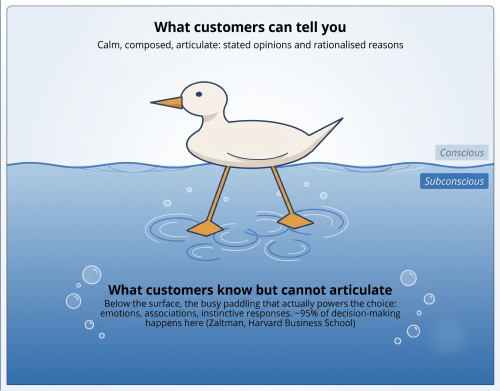
Your Customers Know More Than They Can Tell You
Every year, thousands of new products launch on the back of research that said they would succeed. Concept tests came back positive. Focus groups nodded along. Survey respondents said,