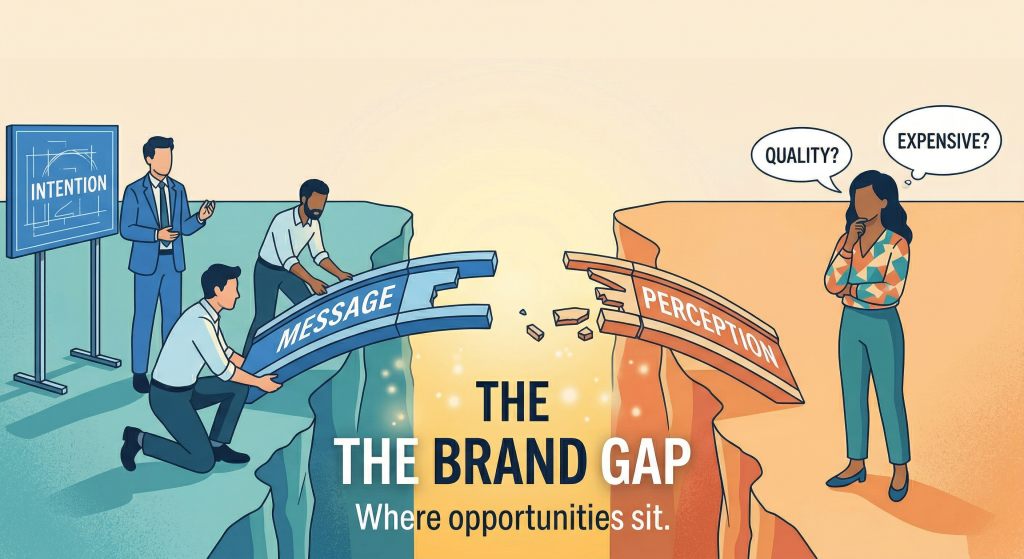
There’s a gap in most markets that doesn’t show up in product specs or competitive audits. It lives in the consumer’s mind, and it is the space between what people are looking for from a brand and what they actually perceive the brands around them to deliver.
That gap is called a brand gap, and finding it is often more valuable than anything a brand tracker will tell you.
Perception is the product
Consumers don’t respond to what a product is. They respond to what they believe it is.
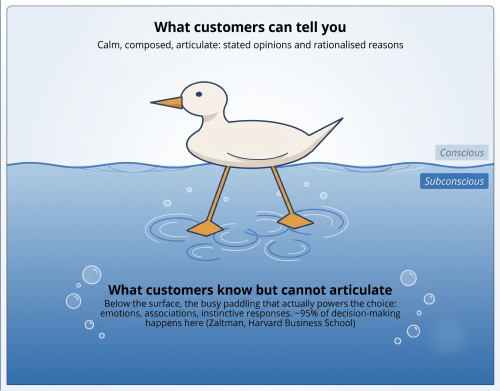
Research in behavioural science has consistently shown that a significant portion of decision-making happens subconsciously. Daniel Kahneman’s work on System 1 thinking, and Gerald Zaltman’s research at Harvard Business School, both point to the same conclusion: around 95% of cognition occurs below conscious awareness. When consumers are asked directly why they chose a brand, the answers they give are often post-rationalisations rather than true drivers.
A study published in the Proceedings of the National Academy of Sciences illustrated this clearly (Plassman et al., 2008). Participants were given identical wines but told some were more expensive than others. Those who believed they were drinking the pricier bottle reported enjoying it more, and brain scans confirmed increased activity in areas associated with experienced pleasure. The wine hadn’t changed. The belief had.
Similar findings emerged from research published in Neuron, where brand knowledge alone influenced both stated preferences and neural responses during a cola taste test (McClure et al., 2004). Same product, different response, depending on what the consumer thought they were drinking.
Brands that have understood this
Volvo didn’t invent car safety, but through consistent, focused messaging, they made safety theirs, so deeply that the association became almost instinctive. Apple has done something similar with design and innovation, shaping perception in ways that influence purchase decisions even when competing products are technically comparable.
Others have used it to redefine their category. Red Bull positioned itself not as an energy drink but as a badge of performance and adventure, built through sponsorships and content rather than product claims. Dove reshaped the conversation around beauty with its Real Beauty campaign, standing for something the category had largely ignored. Tesla established itself as the definitive voice on electric vehicles and held that position even as competition grew.
What these brands have in common isn’t just good marketing. It’s a clear-eyed read on where consumer expectations weren’t being met, and a deliberate decision to own that space.
The gap between intent and experience
Most brand teams genuinely believe they’re delivering on what matters. The problem is that believing it internally doesn’t mean consumers experience it externally.
A brand can deliver on quality, innovation, or trust, and still lose the perception battle if those things aren’t communicated in effective ways. The distance between what a brand intends and what a consumer perceives is where value quietly leaks away.
How we look at it
At Split Second Research, we go beyond what consumers say. Using implicit testing and behavioural science methods, we look at how people subconsciously interpret brand signals, messages, and product benefits, the responses that don’t make it into a survey answer but drive behaviour anyway.
What typically emerges is a more honest picture: where expectations are going unmet, where category needs aren’t being addressed, and where there’s space for a brand to step in and own something meaningful. That’s exactly what our market category analysis looks for.
References
Kahneman, D. (2011). Thinking, fast and slow. Farrar, Straus and Giroux.
McClure, S. M., Li, J., Tomlin, D., Cypert, K. S., Montague, L. M., & Montague, P. R. (2004). Neural correlates of behavioral preference for culturally familiar drinks. Neuron, 44(2), 379–387. https://doi.org/10.1016/j.neuron.2004.09.019
Plassmann, H., O’Doherty, J., Shiv, B., & Rangel, A. (2008). Marketing actions can modulate neural representations of experienced pleasantness. Proceedings of the National Academy of Sciences, 105(3), 1050–1054. https://doi.org/10.1073/pnas.0706929105
Zaltman, G. (2003). How customers think: Essential insights into the mind of the market. Harvard Business School Press.
Latest Posts
Join Our Newsletter
Subscribe to our email newsletter to keep up to date with our latest insights, news, and findings on market research, implicit testing and our occasional psychological ‘neuro-nuggets’ of wisdom.
Our blog

The Free Sample Trap: Why On-the-Spot Feedback Tells You What People Think You Want to Hear
Six years ago we created a comic strip about a couple trying a free product sample at a shopping centre. At the

Your Customers Know More Than They Can Tell You
Every year, thousands of new products launch on the back of research that said they would succeed. Concept tests came back positive. Focus groups nodded along. Survey respondents said,
You think ads don’t work on you. That’s exactly the problem.
75% of people asked to rate an ad, claim advertising doesn’t affect them.
So what exactly are they rating? And why are we