Analysing your

brand equity and brand positioning

Why do people buy the things they buy and why should they choose you? Is there a gap in the market?

split second research neuromarketing company
What is Brand Equity?

Brand equity is the intangible value of a brand.

It can be thought of as the values the brand is perceived to have, in comparison with its competitor brands in the same category.

Brand positioning chart
What do we test when we measure brand equity and brand positioning?​
We measure brands, products, or services that sit in a particular market category. We most often begin with Market Category Analysis and then drill down to each brand in the category. We present images or descriptions of products from the category.
What are the outputs when we measure brand positioning?​
  1. The strengths and weakness of each brand, ways in which they appeal to consumers in the category and shortcomings
  2. Brand associations – we learn what consumers associate with each brand
  3. When used with our Market Category Analysis, we can identify missed opportunities – consumer wants and needs that brands are not addressing
  4. Buyer personas discovered through segmentation analysis and the brands each tends to buy
Why is an implicit response testing great for understanding brand equity and positioning?

To analyse brand equity, researchers use a combination of implicit and explicit tests.

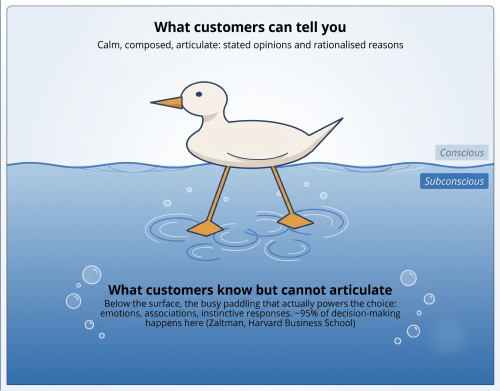
Many purchases are said to be based on nonconscious, gut-reactions. In other words, consumers find it difficult to fully account for their buying behaviour, especially why they choose one brand over another. Implicit response tests, through the IAT or affective priming, is a technique that has its origins in Fazio, Sanbonmatsu, Powell, and Kardes (1986) and has been used to understand the formation and expression of preferences (e.g., Steinman & Karpinski, 2009; Friese, Wänke, & Plessner, 2006). Although it is one of the least expensive techniques in the neuromarketing range of techniques, it can provide more information as to WHY people choose the products they buy at a detailed level.

Implicit tests measure consumers’ subconscious associations with a brand. These are associations such as emotional responses and automatic thoughts. Implicit reaction tests provide valuable insights into how consumers truly feel about a brand. These insights go beyond what respondents may express in a survey or focus group.

Explicit tests, on the other hand, measure consumers’ conscious attitudes towards a brand. These are attitudes such as their perceptions of the brand’s quality, reliability, and value. Explicit tests provide valuable insights into how consumers rationally think. They may rationally weigh the pros and cons of a brand when making purchasing decisions.

References

Fazio, R. H., Sanbonmatsu, D. M., Powell, M. C. & Kardes, F. R. (1986). On the automatic activation of attitudes. Journal of Personality and Social Psychology, 50, 229-238. https://psycnet.apa.org/doi/10.1037/0022-3514.50.2.229 

Friese, M., Wänke, M., & Plessner, H. (2006). Implicit Consumer Preferences and Their Influence on Product Choice. Psychology & Marketing, 23(9), 727–740. https://doi.org/10.1002/mar.20126

Steinman, R. B. & Karpinski, A. (2009). The breadth-based adjective rating task as an indirect measure of consumer attitudes. Social Behavior and Personality: An International Journal, 37, 173-174. http://dx.doi.org/10.2224/sbp.2009.37.2.173

Combining Implicit and Explicit to Gain More Meaningful Insights
Using the results of both implicit and explicit tests, researchers can identify the strengths and weaknesses in a brand’s equity. They can also assess the brand equity of competitors and this yields a huge amount of information about the players in the category. Knowledge is power! Brands can then develop strategies to strengthen the brand’s positive associations based on an informed position.

Great things can happen in a split-second

Fill out an enquiry form and start to see what we can do for your brand. Alternatively, please email Geraldine Trufil at info@splitsecondresearch.co.uk or call: +44 (0) seven eight seven 8 four double five 9 double four

Start A Conversation

Complete an enquiry form to arrange a meeting with us: 

Our blog

Scroll to Top