CASE STUDY

Choosing a Brand Name
Through Implicit Insight

branding agency

The Challenge

Naming a brand is harder than it looks. A London-based branding agency was restructuring and needed a new name, one that could carry real meaning across six brand values and every market they operated in. They had four options. The challenge wasn’t picking a favourite but figuring out which name would actually do the job.

The Solution

The obvious starting point would have been to ask people which name they preferred, or which one they remembered. But preference and memory only tell you part of the story. A name can be easy to recall and still say nothing meaningful about a brand.

So we looked at both. Implicit and explicit brand association tests showed us how people responded instinctively, before they’d had time to form a considered opinion, and how they felt once they had. Memory tests, unprompted free associations, and prompted behavioural questions filled in the rest. The goal was to understand what each name actually meant to people, not just what stuck.

The Outcomes

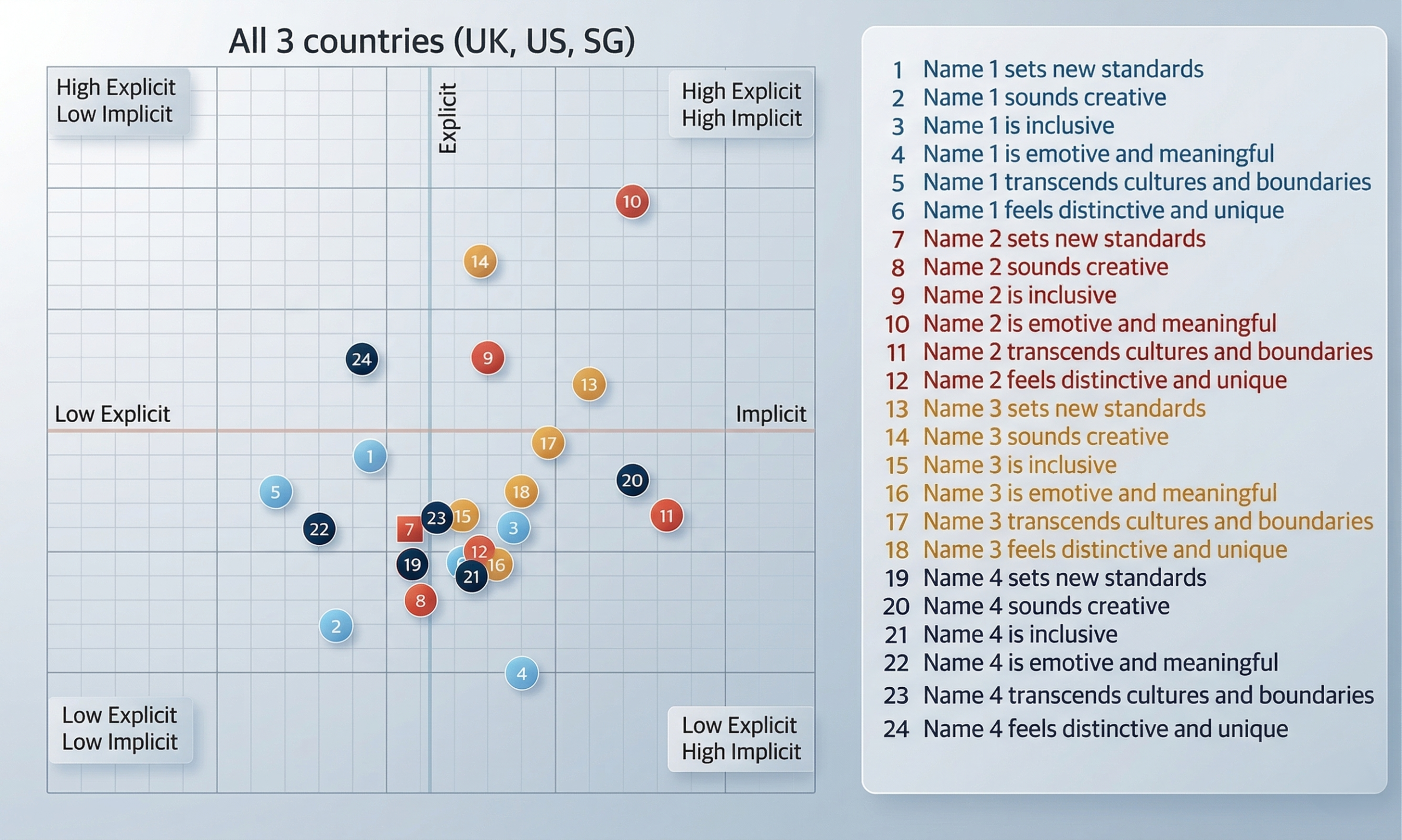
chart

One name was the clear winner on recall. People remembered it easily, straight away and days later. If memory were the only measure, it would have been a straightforward decision, but when we looked at what it stood for, the brand values weren’t really there. It was memorable without being meaningful.

Another name had decent recall, some positive associations, and nothing to put you off. The kind of option that feels reasonable until you realise it doesn’t feel like anything in particular.

But one name kept surfacing the right associations in the unprompted responses including creativity and setting new standards, without anyone being pointed in that direction. And more importantly, it didn’t bring up anything negative. When that pattern showed up in the implicit measures too, it told us that this wasn’t a name people liked when they thought about it but a name that was already doing the right work before anyone had stopped to think about it.

The fourth name had something different going for it: distinctiveness. People saw it as unique, and it held up well across different markets. But the free responses flagged some negative associations, and that’s worth taking seriously before committing to a name you’re going to be living with for a long time.

No single name ticked every box but that’s rarely how it works. The research gave the agency a clear view of what each name was actually doing including its strengths and its risks. That’s what made the decision informed rather than a guess.

If you’d like to understand how this approach can be applied to your own challenge, get in touch with one of our market research experts, here.

Case Studies

Scroll to Top